
Introduction
Kidney stones are one of the most painful conditions a person can experience — and if you or someone in your family has ever had one, you already know how suddenly and severely the pain can strike. While smaller stones can sometimes pass on their own with fluids and medication, larger stones are a different matter entirely. They can block urine flow, cause repeated infections, and lead to serious kidney damage if left untreated.
This is where PCNL surgery comes in. Percutaneous Nephrolithotomy — or PCNL — is a minimally invasive surgical procedure specifically designed to remove large or complex kidney stones that cannot be managed by other methods. Dr. Arpit Panchal at Shree Hospital and ICU, Vadodara performs PCNL surgery with precision and care, helping patients find lasting relief from kidney stone pain and complications.
In this article, we will explain exactly what PCNL is, how it works, who needs it, and what you can expect before, during, and after the procedure.
What Are Kidney Stones?
Kidney stones are hard deposits of minerals and salts that form inside the kidneys. They develop when certain substances in the urine — such as calcium, oxalate, and uric acid — become too concentrated and begin to crystallise.
Stones can vary greatly in size. Some are as small as a grain of sand and pass through the urinary tract without causing much trouble. Others grow to the size of a pea, a marble, or even larger — and these are the ones that cause the most problems.
Common symptoms of kidney stones include:
- Sudden, severe pain in the back or side — often described as one of the worst pains imaginable
- Pain that radiates to the lower abdomen and groin
- Blood in the urine, which may appear pink, red, or brown
- A burning sensation or pain while urinating
- Frequent urge to urinate
- Nausea and vomiting
- Fever and chills — which may indicate an infection
If you are experiencing any of these symptoms, it is important to seek medical attention promptly. Dr. Arpit Panchal at Shree Hospital and ICU, Vadodara can assess your condition and advise on the most appropriate treatment.
How Are Kidney Stones Normally Treated?
Treatment for kidney stones depends primarily on their size and location.
Small stones — generally under 5 to 6 mm — may be managed conservatively with increased fluid intake, pain relief, and medications that help relax the ureter to allow the stone to pass naturally.
Medium stones — between 6 mm and 20 mm — may be treated with a non-invasive procedure called Shock Wave Lithotripsy (SWL), which uses sound waves to break the stone into smaller fragments that can then pass through the urine.
Large stones — over 20 mm, or stones that are causing a blockage, infection, or significant symptoms — typically require surgical removal. This is where PCNL is the treatment of choice.
What Is PCNL Surgery?
PCNL stands for Percutaneous Nephrolithotomy. Let us break that down:
- Percutaneous means through the skin
- Nephro refers to the kidney
- Lithotomy means removal of a stone
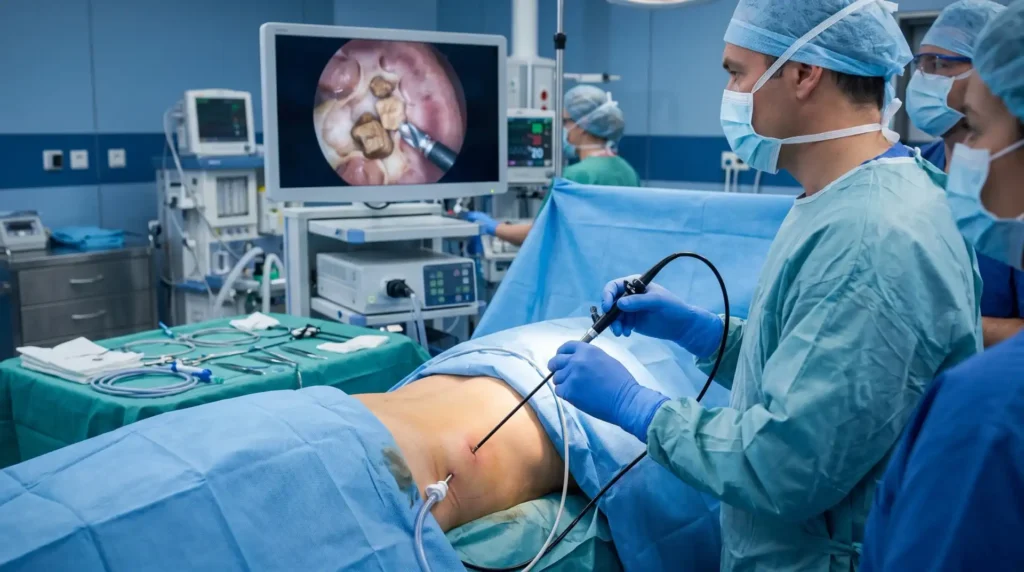
So PCNL is literally the removal of a kidney stone through the skin — via a small keyhole incision in the back, directly into the kidney. It is a minimally invasive procedure that avoids the need for a large open surgical cut while still allowing the surgeon to access and remove even very large or complex stones effectively.
How Does PCNL Surgery Work — Step by Step
Here is a straightforward explanation of what happens during a PCNL procedure at Shree Hospital and ICU, Vadodara:
Step 1 — Anaesthesia
The procedure is performed under general anaesthesia, so you will be completely asleep and will not feel anything during the surgery.
Step 2 — Positioning
You will be positioned lying face down on the operating table so that the surgeon can access the kidney from the back.
Step 3 — Creating the access point
Using imaging guidance — typically X-ray or ultrasound — Dr. Arpit Panchal makes a small incision of about 1 cm in the skin of the back. A thin needle is passed through this incision, through the skin and muscle, and directly into the kidney.
Step 4 — Creating a working channel
The needle tract is gradually widened using a series of dilators to create a channel just large enough to pass a thin tube called a nephroscope into the kidney.
Step 5 — Locating and removing the stone
The nephroscope — a thin surgical instrument with a camera and light — is passed through the channel into the kidney. The surgeon can now see the stone directly on a monitor. Depending on the size of the stone, it is either removed whole or broken into smaller pieces using a laser or ultrasonic device first, and then removed through the channel.
Step 6 — Placing a drainage tube
At the end of the procedure, a small tube called a nephrostomy tube is usually placed in the kidney to drain urine and any remaining stone fragments. This is typically removed within a day or two after surgery.
The entire procedure usually takes between 1 to 2 hours depending on the size and complexity of the stone.
Who Needs PCNL Surgery?
PCNL is recommended in the following situations:
- Kidney stones larger than 20 mm that are too large to pass on their own or be broken by shock wave therapy
- Stones in locations within the kidney that make other treatments ineffective
- Stones that are causing a complete or partial blockage of urine flow from the kidney
- Stones associated with repeated urinary tract infections that do not resolve
- Stones that have not responded to other treatment methods such as shock wave lithotripsy
- Patients with a single kidney where stone removal needs to be thorough and complete
Dr. Arpit Panchal will assess your stone using ultrasound, X-ray, or CT scan to determine whether PCNL is the right approach for your specific case.
What Are the Advantages of PCNL Over Open Kidney Stone Surgery?
Before PCNL became available, large kidney stones required open surgery — a procedure involving a large incision in the side or back, significant blood loss, a long hospital stay, and a recovery period of several weeks.
PCNL changed this dramatically. Compared to open kidney stone surgery, PCNL offers:
- A much smaller incision — just about 1 cm versus 10 to 20 cm for open surgery
- Significantly less post-operative pain
- Lower risk of blood loss and wound complications
- A shorter hospital stay — typically 2 to 4 days compared to a week or more
- Faster return to normal daily activities
- Equally effective stone removal — in experienced hands, PCNL achieves very high stone clearance rates
What to Expect Before PCNL Surgery
Before the procedure, Dr. Arpit Panchal will:
- Review your imaging — ultrasound, X-ray, or CT scan — to fully understand the size, location, and number of stones
- Order blood tests and urine tests to assess kidney function and check for any active infection
- Review your current medications — some blood thinners may need to be paused before surgery
- Explain the procedure clearly, answer all your questions, and obtain your informed consent
You will typically be asked to fast from the night before the surgery.
What to Expect After PCNL Surgery
Recovery after PCNL at Shree Hospital and ICU, Vadodara is generally smooth and well-supported:
- You will wake up in the recovery area with a nephrostomy tube draining the kidney and a urinary catheter in place
- Both tubes are usually removed within 1 to 2 days if recovery is progressing well
- Most patients are discharged within 2 to 4 days after surgery
- Some mild discomfort or soreness around the incision site is normal and managed with pain medication
- A follow-up imaging scan is typically performed before discharge or shortly after to confirm the stone has been successfully removed
- Most patients are able to return to light daily activities within 1 to 2 weeks
- Dr. Panchal will advise on dietary changes and fluid intake to reduce the risk of future stone formation
Can Kidney Stones Come Back After PCNL?
Yes — kidney stones can recur, particularly if the underlying cause is not addressed. After your PCNL surgery, Dr. Arpit Panchal will advise you on steps to reduce this risk, which may include:
- Drinking more water — staying well hydrated is the single most effective way to prevent stone formation
- Dietary adjustments — reducing intake of foods high in oxalate such as spinach, nuts, and chocolate, and limiting excess salt and animal protein
- Medications — in some cases, specific medicines may be prescribed to reduce stone-forming substances in the urine
- Regular follow-up — periodic urine tests and imaging to monitor for any new stone formation
Conclusion
PCNL surgery is a safe, effective, and minimally invasive solution for large kidney stones that cause pain, blockage, or infection. It avoids the need for a large open incision, offers a faster recovery than traditional open surgery, and in experienced hands provides excellent stone clearance.
If you have been diagnosed with a large kidney stone, or if you have been experiencing persistent kidney stone symptoms, do not delay seeking a surgical opinion. Dr. Arpit Panchal at Shree Hospital and ICU, Vadodara is available for consultation and will guide you through all your treatment options clearly and honestly.